

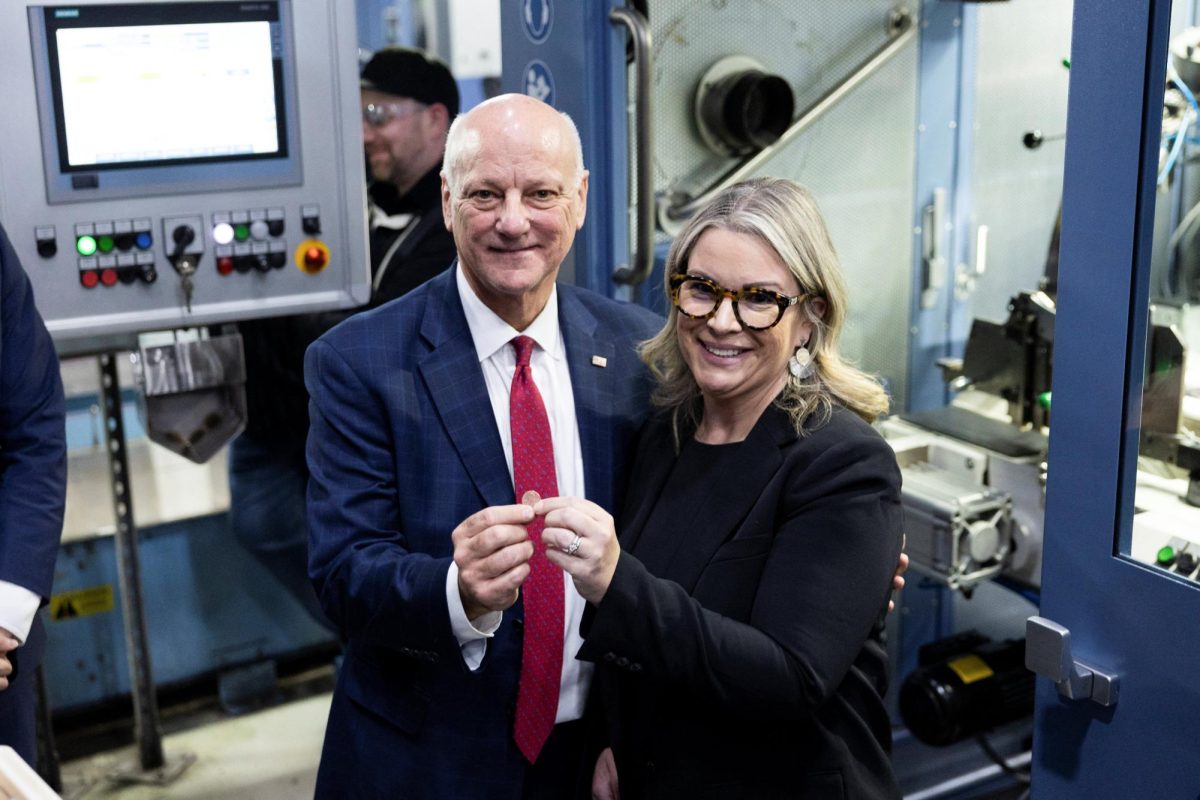
On Nov. 12, 2025, the final U.S. penny was created– referred to as minting– ending a production that began in 1787. According to The Washington Post, this occurred nine months after President Trump instructed the Treasury Secretary, Brandon Beach, to end penny mining when posting on Truth Social, “For far too long the United States has minted pennies which literally cost us more than 2 cents… I have instructed my Secretary of the US Treasury to stop producing new pennies.” Since many people no longer use cash, officials felt it didn’t make sense to continue producing them, leading to the last penny made during a small ceremony at the Philadelphia mint, with applause breaking out after the production was officially concluded.
The event wreaked havoc through the business industry of the United States because of the immediate action of this order without any protocol. According to CBS News, “ ” for as long as 30 years, businesses have been advocating for the abolishment of the penny because of the lack of circulation and the cost of creating a penny. The penny has not been circulating throughout the system, and the penny has become less valuable with inflation. As prices go up, there is nothing to spend only a cent on. This means that pennies are really only used by businesses to give change to customers. This means that clerks give customers pennies, and they pocket them, never to circulate back to the businesses to reuse, so there have recently been shortages of pennies for businesses. The major way pennies are provided back to businesses is by the government, which makes the pennies and distributes them. Businesses are now altering prices in a rush due to the unanticipated change, clerks complaining they wanted the penny gone, but not with this immediate change without prior notice. According to USA Today, it takes about four cents to make a penny, which is four times its monetary value, and because of this, the discontinuation of the penny is expected to save the government and taxpayers more than 56 million dollars annually. This explains the end of the pointless system of the government making overpriced, nonvaluable pennies to get kept in jars and piggy banks in the homes of consumers and never see the light of day.

The penny currently shares an important similarity to the two-dollar bill: both circulate slowly, causing a questioning of necessity. The two-dollar bill, although still currently being produced, has always been somewhat rare. Compared to the one-dollar bill, there are roughly nine times more one-dollar bills than two-dollar bills in circulation, with 11.7 billion one-dollar bills and only 1.5 billion two-dollar bills. Paying with a two-dollar bill is not a common transaction, so there is less demand for them to be remade due to less wear on the bill. Stated by The Hill, in 2013, 2017, 2018, 2020, and 2023, there were no two-dollar bills put into the monetary system because of the low demand and slow circulation. When people pocket two-dollar bills, like pocketing pennies, it is taken out of circulation and has less need to be replenished. This brings up the question of what the future of the penny may entail.
Overall, the end of the penny reveals a broad shift in the U.S. economy towards efficiency and cost-effectiveness. Eliminating the penny is not only practical but economically beneficial. As practicality becomes the main focus in society, outdated currency like the penny no longer makes sense. The confusion after its removal caused issues for businesses, but ultimately made it clearer how rarely pennies are used and at a high expense. Looking at these economic effects, eliminating the penny is part of a larger move towards a more modern and efficient money system.