
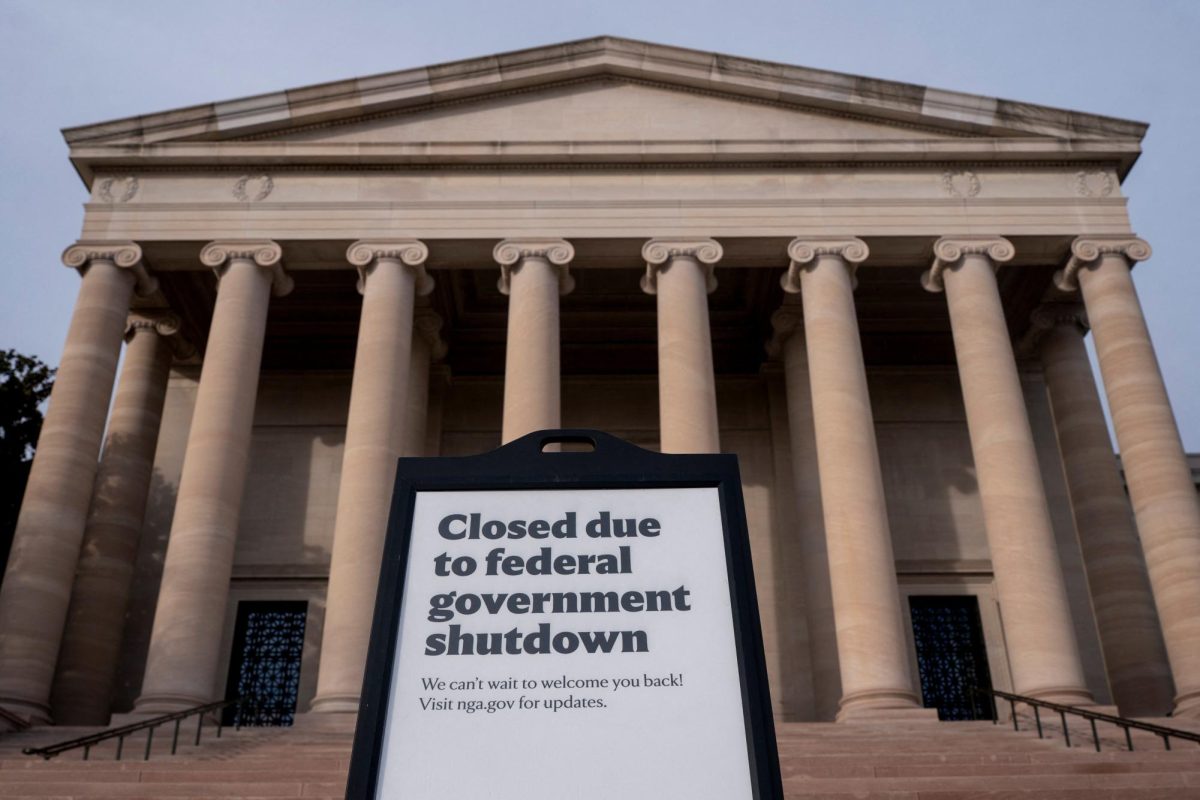
Oct. 1 began a record-breaking, 43-day government shutdown, the longest in the country’s history. Prior to this, the now second-longest government shutdown was also under Donald Trump’s presidency during his first term in 2018. A government shutdown can happen for various reasons, most involving a polarization of the political parties. This means that the Democratic and the Republican representatives in Congress disagree on a topic, so no legislation is passed. The cause of this most recent shutdown was a disagreement on a spending bill. Since the government had not passed the spending bill, it had no authority to spend money; as a result, no one was paid, and the government shut down. According to PBS, Democrats originally did not agree on the spending bill because the Republicans did not guarantee an “extension of an enhanced tax credit that lowers the cost of health coverage obtained through Affordable Care Act marketplaces.” The Affordable Care Act works to make health insurance affordable by providing US citizens with subsidies. This conflict led to a back-and-forth battle between the two parties, as Republicans “promised Democrats a December vote on the tax credit extension to help resolve the standoff,” but Democrats wanted it included in the spending bill. As a result of the shutdown, President Trump called for the suspension of Supplemental Nutrition Assistance Program (SNAP) benefits (benefits that provide essential aid for low-income households), which meant that roughly 41.7 million people would not be able to put food on the table. Eventually, Democrats agreed on a short-term spending bill, which is set to expire Jan. 30, 2026. According to NPR, in total, the shutdown cost the United States $15 billion.
Many federal departments were left unpaid during this time, but the department that received the most news coverage, and likely directly affected the most people, was the Transportation Security Administration (TSA). The many TSA agents continued to work, but due to a job shortage the airports had to cut flights. According to the BBC, an emergency order stated that 10% of all domestic flights should be cancelled, and “in the first week of November, thousands of flights were cancelled and even more delayed.” As a result, many people were unable to get where they needed to be. This also left many worried about their holiday plans. However, since the shutdown ended, all restrictions were lifted, so holiday travel should flow smoothly.
According to NPR, during the most recent shutdown, roughly 1.4 million federal employees were not paid. While some people were furloughed (unpaid leave), most employees were expected to work without pay. Additionally, according to Bipartisan Policy, the following federal employees were affected during the 43-day period: “civilian employees at the Department of Defense, Health and Human Services, the Department of Veterans Affairs, the Executive Office of the President, and a few other agencies.” In regards to retroactive pay, most federal workers, including furloughed employees, should receive some, if not all, of their pay. According to Federal News Network, “A senior Trump administration official said the White House ‘has urged agencies to get employee paychecks out expeditiously and accurately to not leave anyone waiting longer than necessary.’”
The reimbursement for the unpaid employees is set to help a lot of people, but it isn’t that simple. There are still employees waiting to hear if they have a job to come back to. As mentioned above, some employees were furloughed, or they entered Reductions in Force (RIFs), the stage at which the employees’ work is no longer needed due to budget cuts. With the reopening of the government, many of these employees were welcomed back to their jobs; however, some were not. According to the Government Exclusive, during the shutdown, RIFs were enforced in the “departments of Health and Human Services, Education, Treasury, and Housing and Urban Development”. They were supposed to be reversed when the government reopened, but they have not. According to ABC, there are 670,000 federal employees jobless. Additionally, the same ABC article claimed that 60,000 non-federal employees lost their jobs due to the economic impacts, as there is a shortage of spending during shut downs, this slowly trickles down to affect the jobs of individuals who are not involved in the government.
There is still uncertainty for federal employees, as the government only agreed on a spending bill through Jan. 30, 2026. This could mean that the government is subject to a shutdown again if Congress does not agree on a longer-term spending bill. Hopefully, Congress will come to an agreement, so US citizens do not have to suffer.