
Tariffs have been one of the topics at the forefront of many Americans’ minds since President Trump began his first term. They were announced on Jan. 26, 2025, targeting Canada and Mexico with a 25% tariff. According to Congress.gov, the Constitution grants Congress the ability to “regulate foreign commerce, impose import tariffs, and raise revenue.” Therefore, tariffs require Congressional approval. However, the same source says that the president “has authority to impose tariffs under certain conditions.” This is the foundation on which Trump has been relying to avoid the gridlocked Congress. Trump has been using the 1977 International Emergency Economic Powers Act (IEEPA) as the basis of his tariff policy. Former President Jimmy Carter created this act during a crisis, when Iran took American diplomats as hostages. As a result, Carter created the act to freeze all of the resources exporting to Iran. Since 1977, the act has been unpaused following 9/11, and most recently by the Trump Administration.
Trump first tried to enact IEEPA during his first term. Most notably, he threatened Mexico with tariffs, though they never took action, as an agreement was met. According to the BBC, to begin his second term, using the same act, he initiated tariffs on over 90 countries, ranging from 10-50%.
Who pays the Tariff?
During President Trump’s one-hour and 47-minute State of the Union address on Tuesday, Feb. 24, he claimed that tariffs are “paid for by foreign countries.” However, according to a New York Times analyst, “nearly 90 percent of the tariffs’ economic burden fell on U.S. firms and consumers.” As a result, US companies are having to pay significantly more for their imported materials. While tariffs are impacting companies differently, one industry that is getting hit hard by tariffs is the automobile industry. According to USA Today, car companies such as Ford, Mercedes-Benz, Volkswagen, Stellantis, General Motors, and Toyota have lost an estimated $18.1 billion. Toyota has had to pay the most with $9.6 billion.
Since companies are forced to pay these tariffs, this impacts you. According to EconoFact, at the end of 2025, there was an increase of 5.4% on imported goods and a 3% increase in domestic goods. While this may seem like a minor increase, it adds up quickly. Anything from the groceries you buy in the store to the clothes you buy has likely been impacted by tariffs. According to the U.S. Congress Joint Economic Committee, the average American family has paid roughly $1,745 extra in the rising costs of goods due to tariffs.
What was the Supreme Court Ruling?
According to the New York Times, on Feb. 20, 2026, in a 6-3 ruling, the Supreme Court concluded that the President “exceeded his authority when he imposed tariffs on nearly every U.S. trading partner last year.” Moreover, they ruled on the grounds that the IEEPA does not support his tariffs, making them unconstitutional. The IEEPA Act is used for times of crisis, and arguably, the United States is not at a time of severe economic or global conflict. However, this ruling was a bit surprising, as three of the nine justices were appointed by Trump himself, and three more were appointed by Republican President George Bush. Two of the justices appointed by Trump even ruled against the tariffs, which demonstrates how important the issue is, as Democrats and Republicans alike are agreeing that tariffs are hurting the American people.
What did Trump have to say?
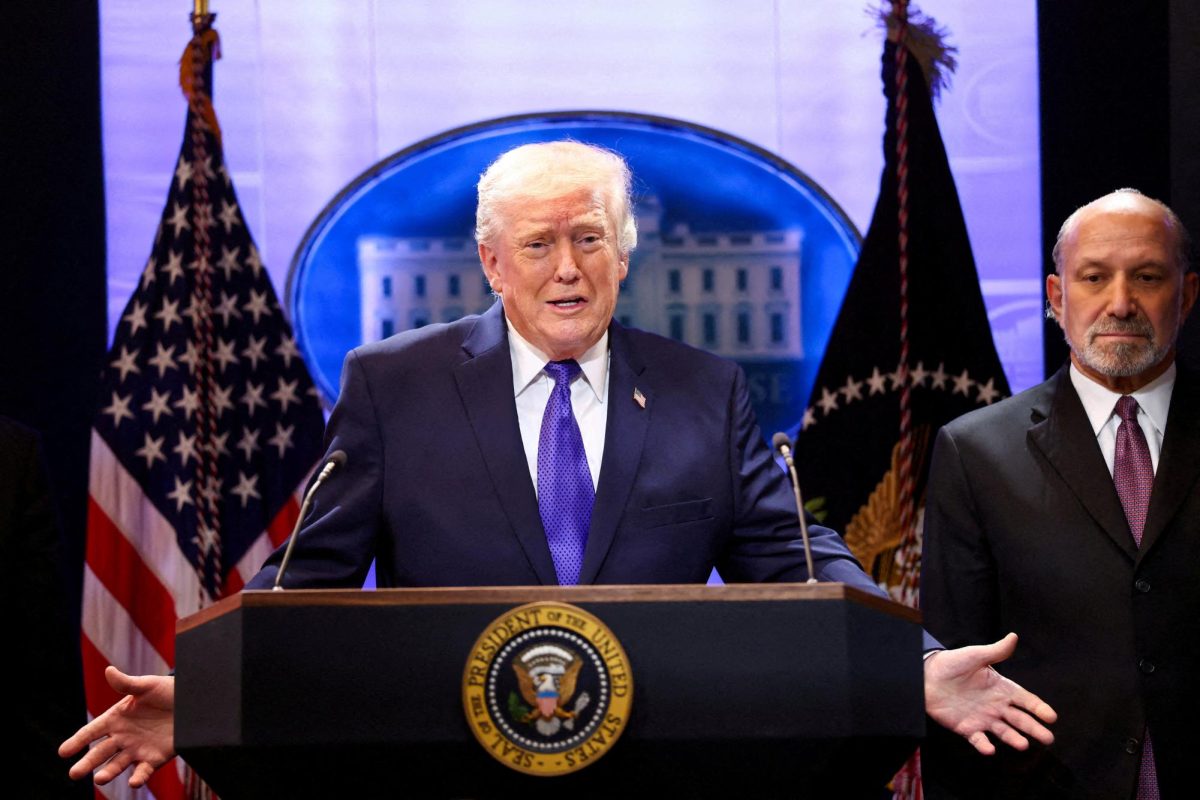
Trump was giving a lecture to a handful of governors when he slipped a note informing him of the Supreme Court’s decision against his tariffs. Later that night, in dramatic dim lighting, Trump held a press conference. According to CNN, he said that the ruling was a “disgrace,” and he even said that those who voted against him were an “embarrassment to their families.”
What comes next?
While Trump insulted the Supreme Court Justices, he went a step further. He raised tariffs from their resting 10% to 15%. According to the BBC, Trump is now using Section 122 of the Trade Act of 1974 to support the increase in tariffs. This is a temporary solution, as the act is used as a “short-term economic safeguard tool, allowing the administration to respond quickly to international financial instability or trade imbalances,” according to Shapiro.com. It is unclear what will happen next regarding the laws that will continue to back tariffs.
Additionally, there is a question of what this means for the businesses, big and small, that have paid billions of dollars towards tariffs. The answer is unclear. The Tariff Refund Act of 2026 is currently in motion, requesting that all companies receive their payments that they made towards tariffs, along with interest. However, Trump has yet to put a plan in motion, as the ruling did not require him to reimburse companies. If companies were to be reimbursed, however, consumers are unlikely to receive any form of compensation, despite the increase in prices.
As the weeks progress, it will be interesting to see how the public’s attention will shift from tariffs to other global conflicts. Tariffs are likely here to stay, due to the president’s infatuation with them. Now the question is, are tariffs actually going to help the economy in the long run?