

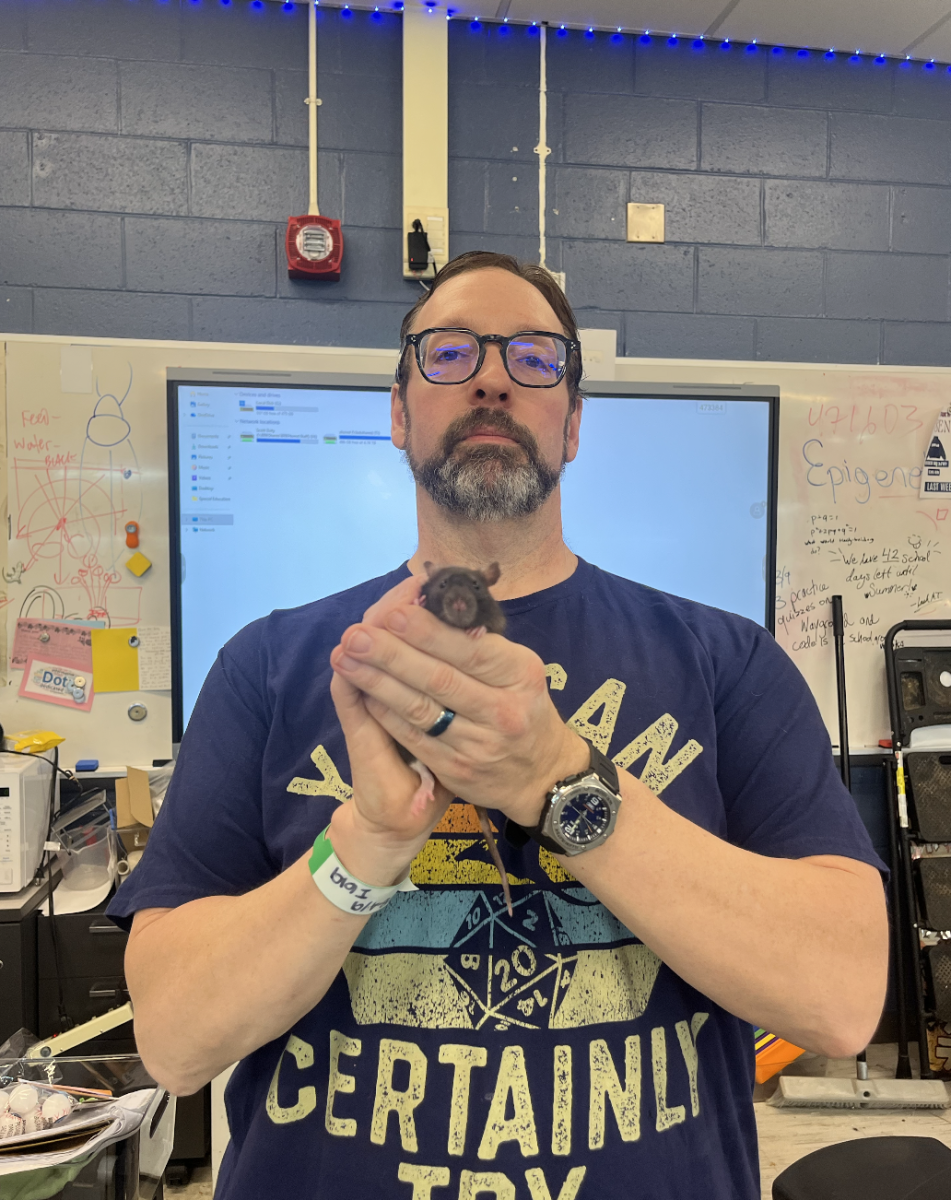
Honors Zoology is a class offered here at BHS to students in 11th and 12th grade. Throughout the year, students learn to study, train, and take care of animals, including rats. Whether teaching them sports, studying their physiological aspect, taking care of them, or simply interacting with the rats, students are constantly collaborating with these rodents and getting to know them. It’s safe to say that the students always have their hands full!
The students of Honors Zoology were assigned with the task of training rats how to play basketball. Not basketball involving dribbling and shooting threes, but instead, the rats must learn how to put a ping pong ball through a small hoop.
This task is a semester-long process of many steps. First, the rat must feel comfortable with the student. This is an important step that usually takes a week. If the rats aren’t used to their handler, they are more likely to relieve themselves during handling. Once the rat and student have become used to one another, the next step is to teach them basic skills. Rats can be trained just like dogs; taught to sit on command, come, and stay.

The rats are then trained to put the ball through the hoop through a long process of repetition and reward. The rats are taught to do the same task until they master it.
After the unit is over the students have the option to take their rats home and often do so. If the rat isn’t taken home by the student, it will either be taken home by Mr. Doty (the Honors Zoology teacher) or fed to the class snake, Zeus.
Rats are commonly misperceived in many ways. Many people view them as scary, mean, and cheese loving, but if you treat them right, they can be very affectionate pets.
Also, if left in a place with a warm climate and good food source, they can survive very well on their own. At Berkley High School, a rat was left in the school over the summer and was able to survive the whole time until students and teachers came back in the fall. It was given the name Speedy because when it was found, no one could catch it.
Another fun fact about the rats is that they don’t actually like cheese that much. They prefer other treats, specifically peanut butter. Additionally, despite being known for disease spreading, they do not carry rabies. Overall, there are many misconceptions about rats and it is important to meet them with an open mind.
Rats are also very social animals, but when put with the wrong pets, it can end badly. One thing to know is that if you are handling or interacting with rats you should not have any snakes in the area. This is because snakes are large predators to rats and will hunt them anywhere in order to get food.
This even happened at Berkley High just a few years ago. In the Honors Zoology class a rat and snake were out at the same time and it did not end well. The snake, in hopes to catch the rat, dove at it but missed the rat and hit a girl in between them. It ended with a hungry snake, a hurt girl, and a saved rat.
In addition to being hunted by snakes, rats are also very sensitive to cold weather because of how small they are. In order to combat this struggle, they are often found laying in groups close to each other to stay warm. Overall, rats are a very smart, but also fragile species, which is why they are taken care of so carefully over the course of this unit.
In the zoology class, having rats in the classroom for an experiment is a fun and interesting way to learn. By training them to play basketball, students get to actually see how rats learn and think instead of just reading about it. The unit helps students understand things like behavior and how animals can be trained using rewards. Overall, this experiment shows that learning can be more exciting when it’s hands-on, and it also helped students see that rats are smarter than some think.